Ptilocercus lowii (pen-tailed tree shrew, extant, Le Gros-Clark 1926) was derived from a sister to Protictis from among the civets and phylogenetically preceded Palaechthon and the colugo, Cynocephalus. Tree shrews were once considered ancestral to primates, such as Notharctus, but cladistic analysis disputes this. The pen-tailed tree shrew is closer to the colugo, far from primates such as Notharctus. The remaining tree shrews of the genus Tupaia, remain basal to primates, but are closer to rabbits and plesiadapids (which were formely considered primate ancestors, but all these taxa lack canines). Ptilocercus lacks the extradermal membranes of Cynocephalus which were developed in convergence with bats. Onychonycteris, a basal bat, and Pteropus, a fruit bat, do not have the broad flat ribs found in microbats such as Icaronycteris and Myotis.
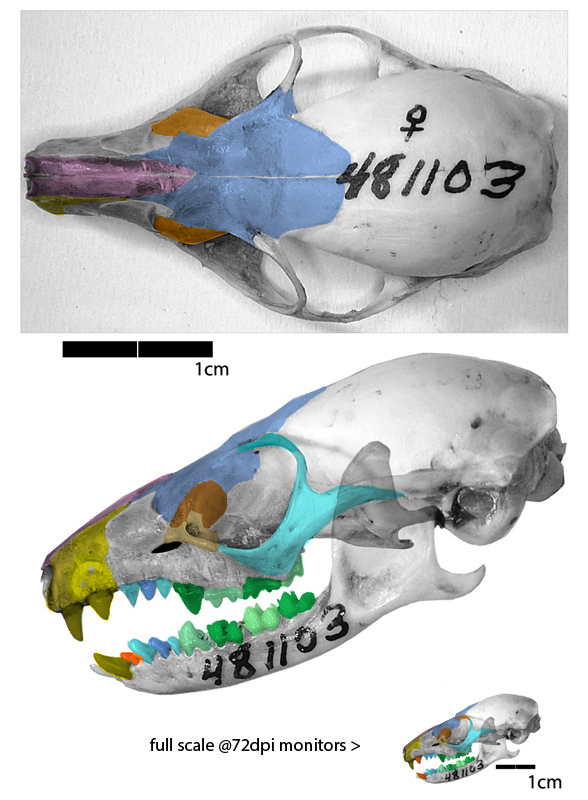
Distinct from Protictis, the skull of Ptilocercus had a larger orbit completely surrounded by a postorbital ring. Contact is lost between the lacrimal (tear duct bone) and jugal (cheek bone). Upper incisor 3 was absent. Upper incisors 1 and 2 were enlarged and sharpened to points. The upper canine was reduced to the size of a premolar. Upper premolar 4 was enlarged to twice the size of premolars 2 and 3. The three upper molars were similar in size to one another and had low cups. Lower incisor 3 was reduced to a vestige as lower incisors 1 and 2 were enlarged to canine size. The lower canine was reduced to less than half the size in Protictis and similar in most respects to premolar 2. Premolar 3 was reduced and 4 was enlarged. The lower molars were similar to each other in size and all had lower cusps.
The special carnivore dental relationship of upper premolar 4 shearing against lower molar 1 is lost because the diet no longer includes bones that need to be cracked. Unfortunately, the current definition of Carnivora makes no allowance for the possibility of an evolution in dentition resulting from a size reduction and a change of diet. Perhaps that needs to be permitted because it seems to have happened.
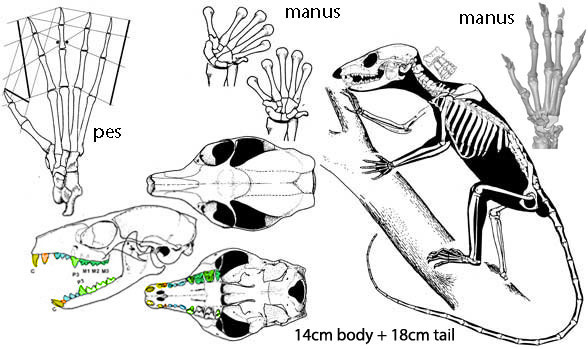
The vertebral spines, once high with inclines and reclines, are now low without much leaning at all. The dorsal ribs, once round and narrow, are now broad and flat (as in bats). The transverse processes of the lumbars, once wide and wing-like, are now no wider than each centrum.
The radius is longer than the humerus. The ulna is reduced distally, to no more than one third the width of the radius (as in bats). The short fingers of Ptilocercus demonstrate the ability to spread so widely that digits 1 and 5 oppose one another by 180º, a character unheard of in mammals other than bats.
The tibia is longer than the femur. The ankles are more flexible. The astragalus and calcaneum move away from stacked one upon the other to more of a side-by-side configuration. The tibial malleolus, which restricts ankle rotation in most mammals is not present in bats but still present in Ptilocercus. There is no longer only one longest toe. Pedal digits 2 through 5 are equal in length and their metatarsals follow suit. The pedal unguals also deepen.
The tree shrew acts like a squirrel, but instead of eating nuts, it eats insects. Tree shrews probably originated before dinosaurs became extinct, ~65 mya, but their fossils go back only 3 million years. Pouncing on prey while perched on a tree branch requires greater skills and a larger brain. To find prey tree shrews rely on their eyes and their hands. |