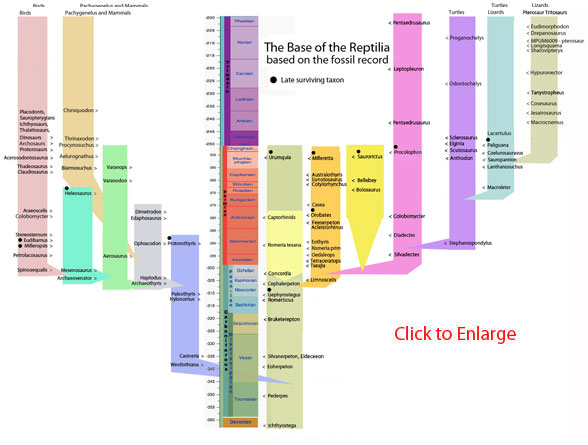
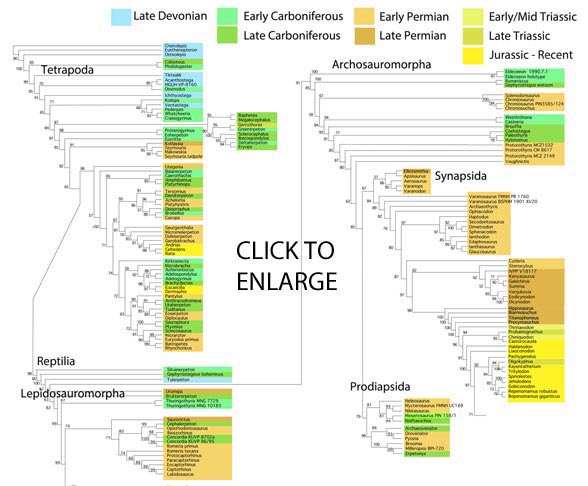
By definition, the Reptilia includes turtles, lizards, snakes, crocodilians and birds, their last common ancestor and all of its descendants. That last common ancestor is Silvanerpeton, according to the large reptile tree. Here, distinct from all prior studies, all known reptiles nest in two major branches with turtles and lizards on one branch and crodilians, birds and mammals on the other.
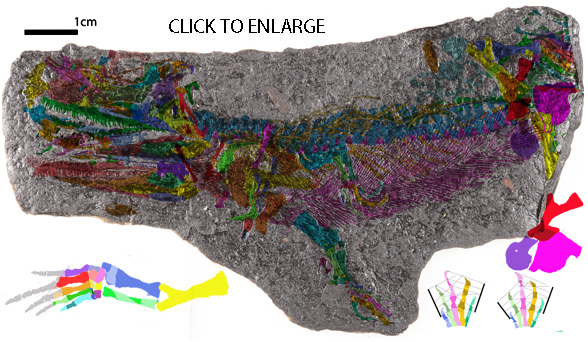
Amphibian-like reptiles (laying amniotic eggs) appear at the base of the Reptilia and the first dichotomy splitting the new Lepidosauromorpha from the new Archosauromorpha using traditional definitions.
The new Lepidosauromorpha, are all those sharing a more recent common ancestor with living lizards, the Lepidosauria, than with Archosauria (Gauthier 1986). The new Archosauromorpha share more traits in common with living archosaurs (birds and crocs) than with Lepidosauria.
This primitive division has not been reported before because all prior studies were more limited in scope. For those interested in obtaining the MacClade data file, click here and make your request.
The term Amniota is commonly and scientifically used to encompass all reptiles, birds and mammals, but in the present tree, the inclusion set of taxa within the Amniota is redundant with the Reptilia. Hence the more recent term, Amniota, can now be dropped from usage.
A quick demonstration of microevolution leading to macroevolution can be found in a series of mandibles from basal tetrapods through synapsids, mammals and humans. Click here for that page.
The book, From the Beginning - The Story of Human Evolution by David Peters (Wm. Morrow publisher) documents 36 steps from single cells through worms, fish, tetrapods, mammals, primates and man while featuring the addition and loss of structures and organs. Click here to read or download it. |