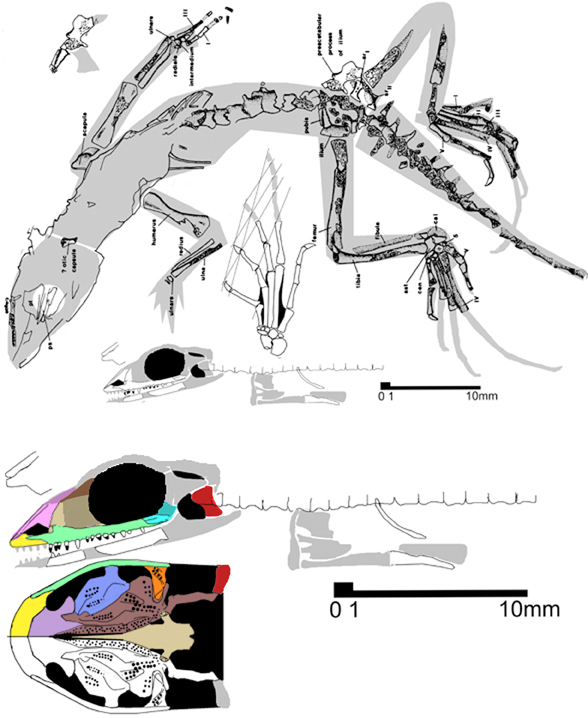
Lacertulus bipes (Carroll and Thompson 1982) ~ Late Permian 255 mya, ~ 5 cm snout/vent length, was originally described as a facultatively bipedal primitive lizard or eosuchian representing a distinct lineage of one or the other. Here Lacertulus was a basal protosquamate derived from a sister to Tijubina and Palaegama. It was a sister to Bavarisaurus and preceded the Daohugo lizard.
Much larger than and distinct from Palaegama, the skull of Lacertulus had a wider premaxilla. The nasal was notched above the naris and did not extend dorsally. The orbit was probably large because the maxilla is very low. The vomers and palatines were much wider. The pterygoids extended anteriorly as far as the palatines did. Distinct from most lizards, the teeth were subthecodont in implantation.
There were ~24 presacral vertebrae. The neural arches were low and not fused to the centra. The neural spines were low to absent. None of the tail vertebrae show any sign of caudal autotomy, which in several living lizards permits the tail to breakoff during an attack and regrow later.
The carpals are tiny but ossified and rounded, rather than locked in a tight mosaic as in many living lizards. The femur was longer than half the glenoid-acetabulum length. The tibia was more robust than the fibula. The astragalus, calcaneum and centrale remained unfused, unlike most lizards. The pes was twice the length of the manus. Metacarpals 1-4 were bound together. The foot was large with a tendril-like digit 4 ideal for arboreal (tree branch) locomotion. |