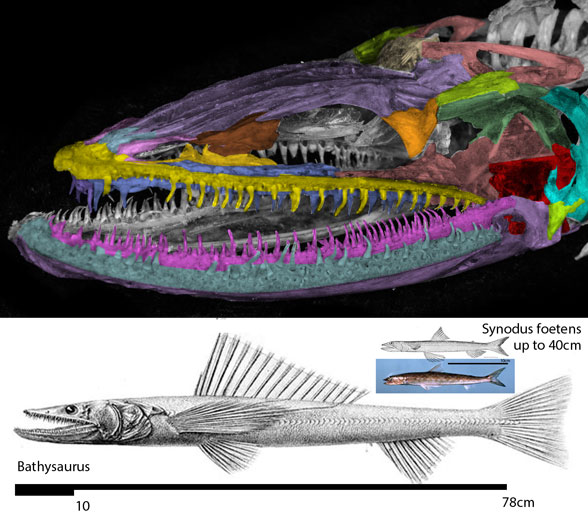
Bathysaurus ferox (Günther 1878, 78cm in length) is the extant deepsea lizardfish.
“The large, well developed eyes, with large pupils, are evidence of the importance of vision for prey detection. Although residual sunlight does not penetrate the depths inhabited by deep-sea lizardfish, their eyes aid in detecting distinct sources of residual or bioluminescent light.”
"Deepsea lizardfish are one of the world's deepest living apex predators, and will not hesitate to eat anything they meet, including their own kind.
"Most of the time, the deepsea lizardfish maintains a motionless stance on the substrate, with head and fore-body raised, waiting for prey. Being well equipped to pursue and devour whole prey, it captures it by lunging forward in a sudden rapid burst, accompanied by a snap of its trap-like jaws."
“Deepsea lizardfish are hermaphrodites, bearing both male and female sex organs, thought to be an adaptation to low population densities. Mature gonads found in samples from November to January off the coast of Virginia show that their reproduction is synchronous, a means of maximizing breeding population densities without increasing the size of the feeding population. Mean fecundity rates of around 32,000 ova per fish were observed for eight specimens. Not much is known about their mating habits; however, larval deepsea lizardfish have been recorded at the surface of the ocean" |