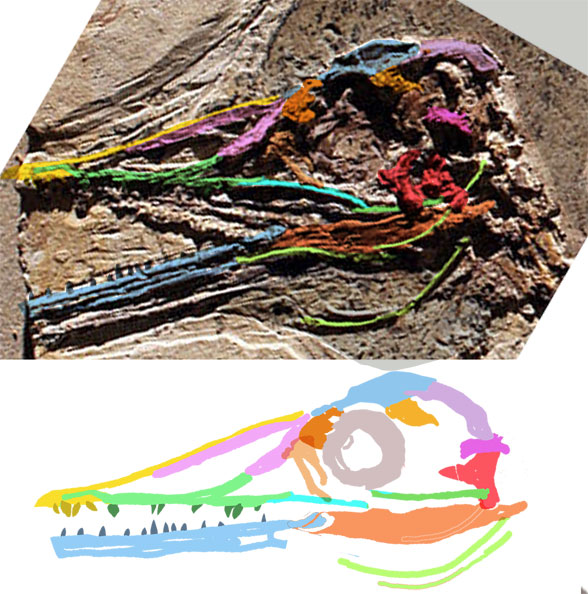
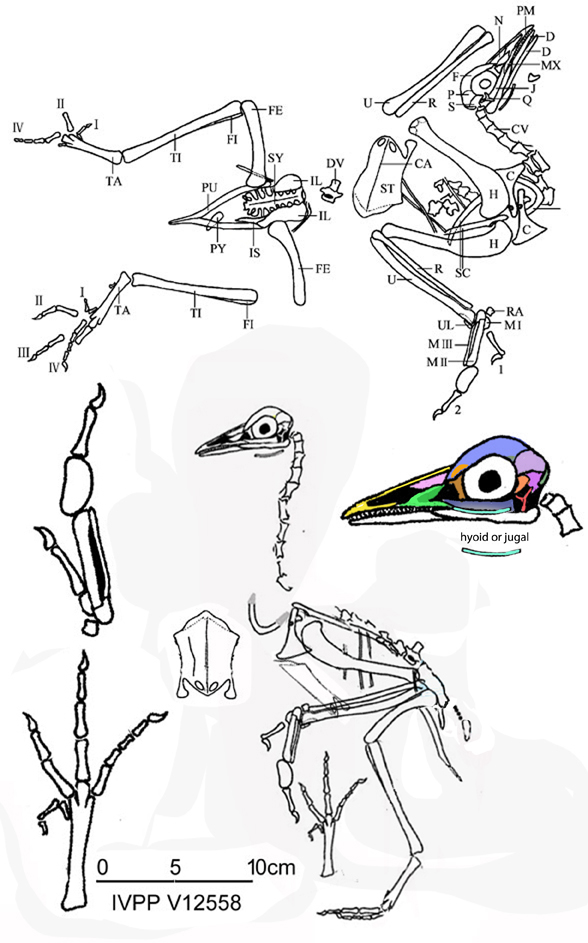
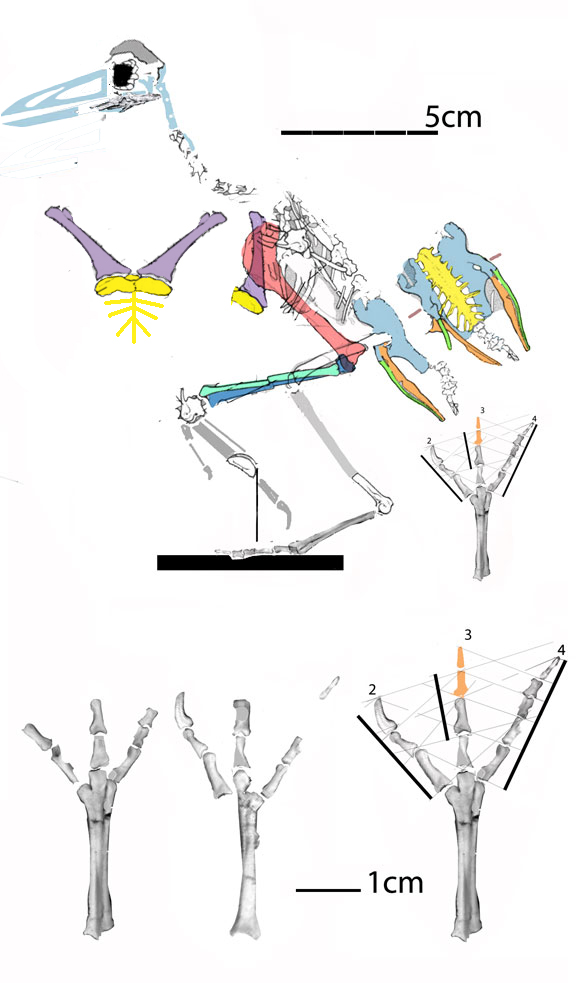
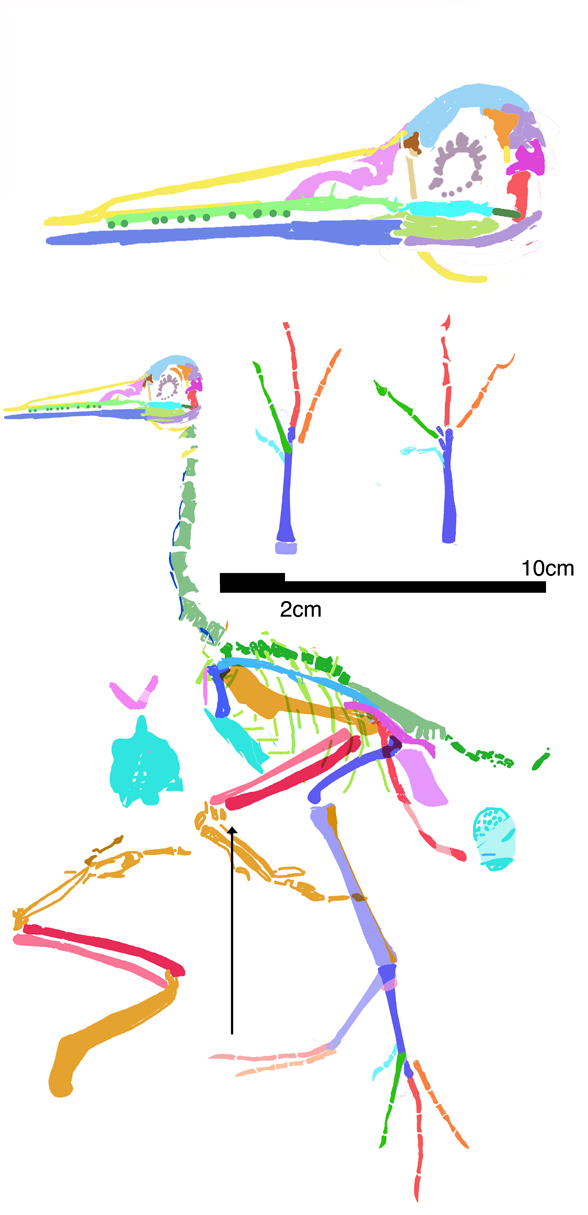
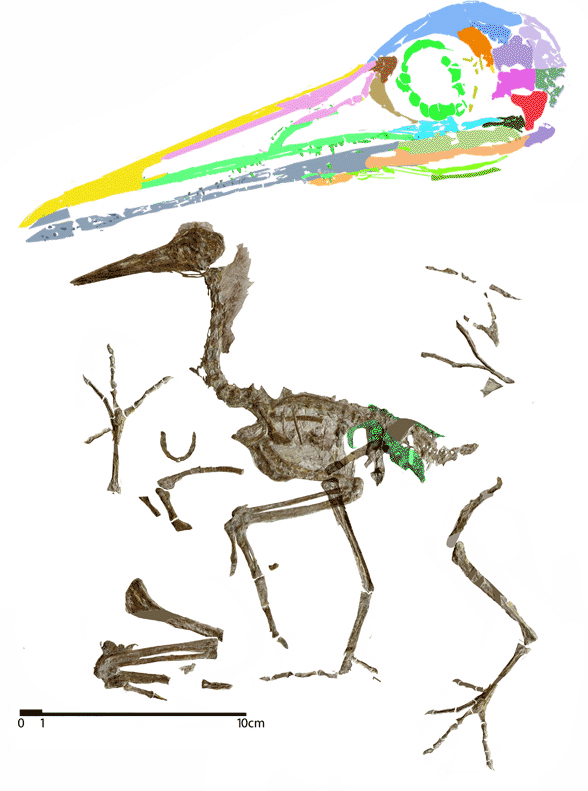
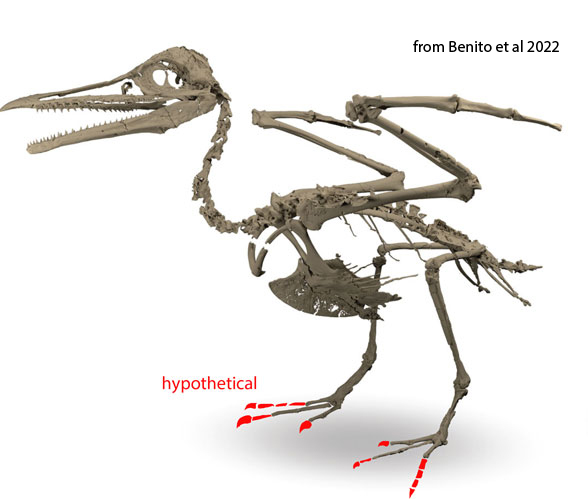
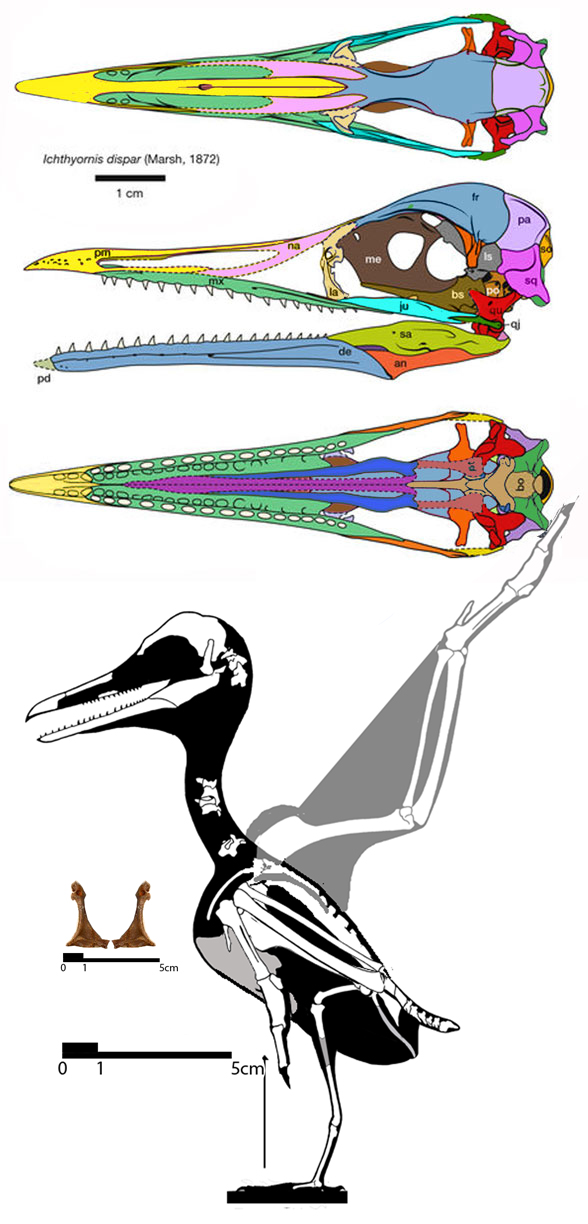
Benito et al (5 co-authors) 2022. Forty new specimens of Ichthyornis
provide unprecedented insight into the postcranial morphology of crownward stem group birds. PeerJ 10:e13919 DOI 10.7717/peerj.13919
Clarke JA and Norell MA 2002. The morphology and phylogenetic position of Apsaravis ukhaana from the Late Cretaceous of Mongolia. American Museum Novitates 3387:46 pp.
Czerkas SA and Yuan C 2002. An arboreal maniraptoran from northeast China. Pp. 63-95 in Czerkas, S.J. (Ed.), Feathered Dinosaurs and the Origin of Flight. The Dinosaur Museum Journal 1. The Dinosaur Museum, Blanding, U.S.A.
Czerkas SA and Ji Q 2002. A preliminary report on an omnivorous volant bird from northeast China. In: Czerkas, SJ (editor): Feathered Dinosaurs and the origin of flight. The Dinosaur Museum Journal 1:127-135.
Huang J, Wang X, Hu Y-C, Liu J, Peteya JA and Clarke JA 2016. A new ornithurine from the Early Cretaceous of China sheds light on the evolution of early ecological and cranial diversity in birds. PeerJ.com
Marsh OC 1872. Notice of a new and remarkable fossil bird. American Journal of Science
4(61):344–380 DOI 10.1080/00222937308696770.
Marsh, OC 1880. Odontornithes, a Monograph on the Extinct Toothed Birds of North America. Government Printing Office, Washington DC.
Martin L 1984. A new Hesperornithid and the relationships of the Mesozoic birds. Transactions of the Kansas Academy of Science 87:141-150.
Norell MA and Clarke JA 2001. Fossil that fills a critical gap in avian evolution. Nature 409:181–184.
Wang R-F, Wang Y and Hu Dong-yu 2015. Discovery of a new ornithuromorph genus, Juehuaornis gen. nov. from Lower Cretaceous of western Liaoning, China. Global Geology 34(1):7-11.
Zhou Z. and Zhang F. 2001. Two new ornithurine birds from the Early Cretaceous of western Liaoning, China. Chinese Science Bulletin, 46 (15), 1258-1264.
Zhang F and Zhou Z 2001. A Primitive Enantiornithine Bird and the Origin of Feathers. Science 290 (5498): 1955-1959.
wiki/Yanornis
wiki/Juehuaornis
wiki/Apsaravis
wiki/Ichthyornis
wiki/Changzuiornis |