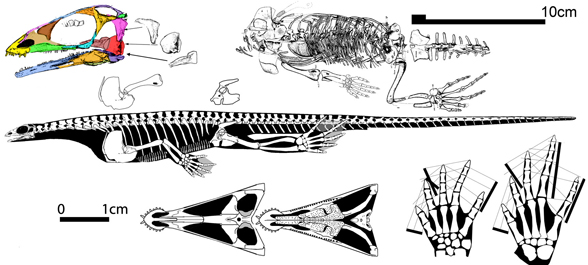
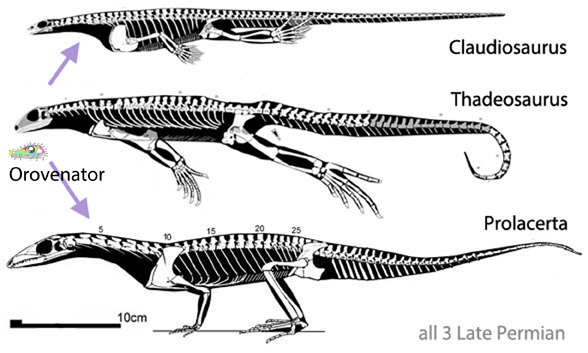
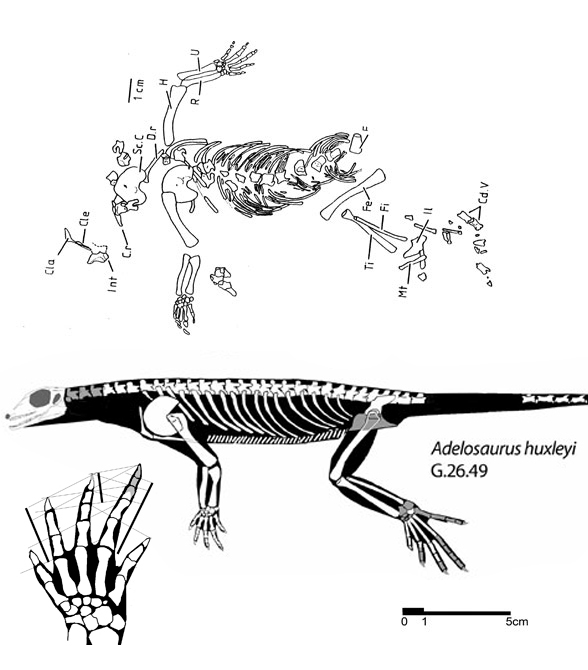
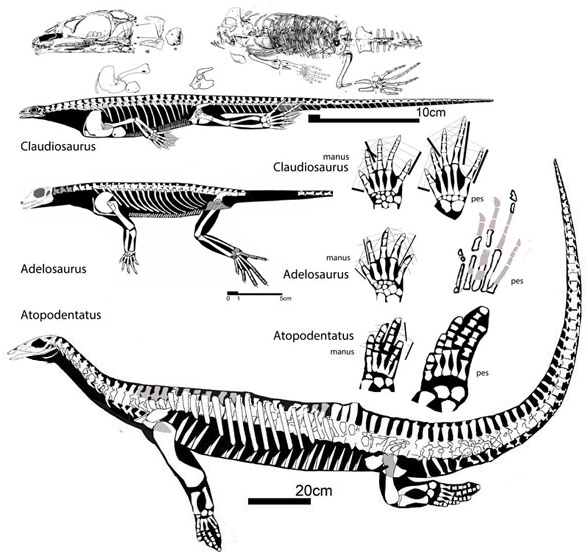
Claudiosaurus germaini (Carroll 1981; Late Permian ~260 mya, 60 cm in length) was originally described as a close relative of Thadeosaurus, and indeed it is. Claudiosaurus also nests with Adelosaurus and Atopodentatus.
The skulls of predecesor taxa, like Hovasaurus, are poorly known, so distinct from Spinoaequalis, the reduced skull of Claudiosaurus had a premaxilla enlarged to a third or more of the rostral length. The premaxilla ascending process split the nasals. The naris is elongated horizontally perhaps just contacting the lacrimal. The jugal was gracile. The supratemporal was a small oval. A quadratojugal was present contacting both the jugal and the squamosal + quadrate, but other workers have not recognized that loose bone as the quadratojugal. A retroarticular process was present.
The number of cervicals increased to at least nine and they decreased in size cranially. The posterior cervicals were as tall as the little skull. The cervical neural spines were taller than each centrum. Intercentra were absent. The pre sacral number of vertebrae dropped to 24. Metacarpals 3 and 4 were subequal.
A few cranial elements were originally misidentified and this led to some confusion regarding the phylogenetic nesting of Claudiosaurus. Here the elements are returned to their natural positions. Claudiosaurus had a large quadratojugal that closed off the base of its lateral temporal fenestra and making it a traditional diapsid, similar in most respects to Petrolacosaurus.
|