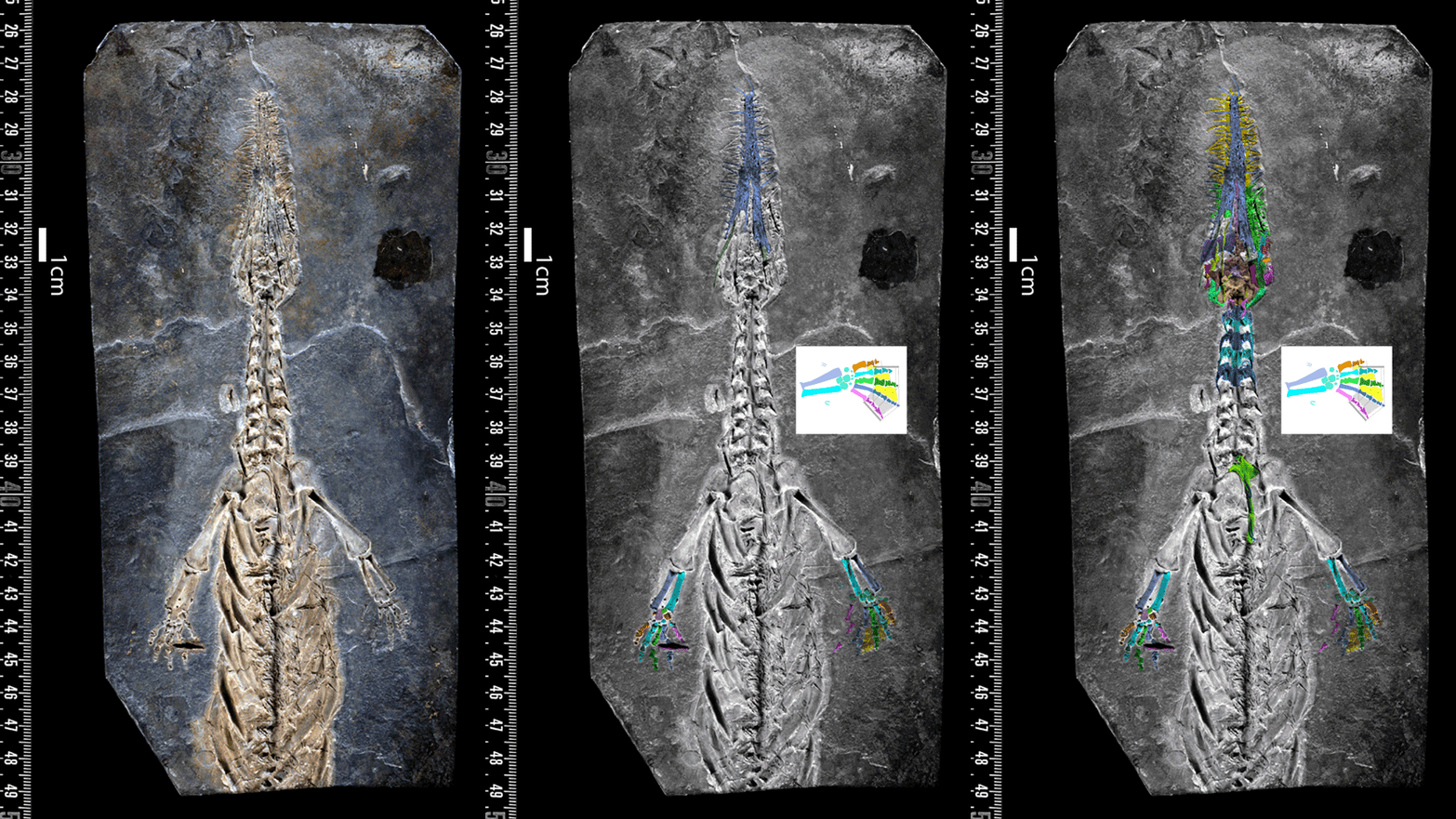
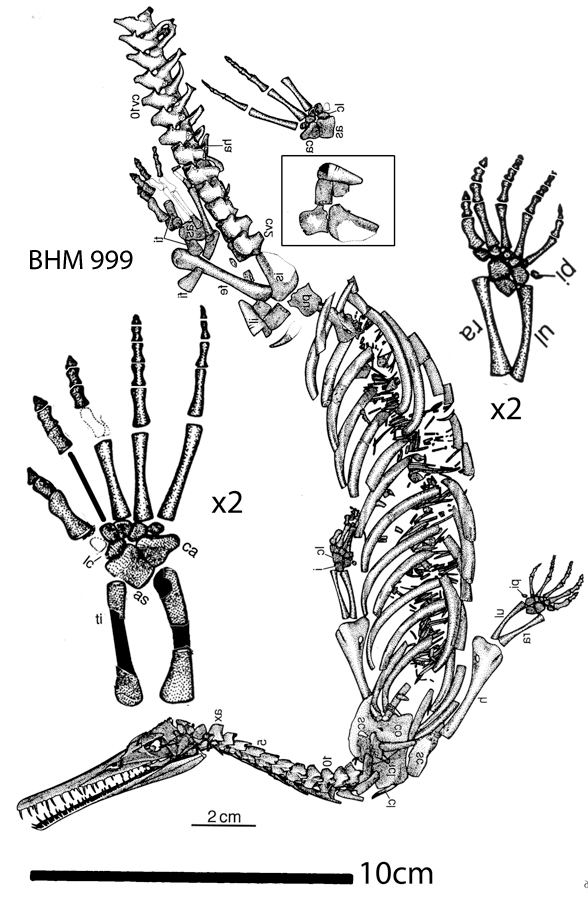
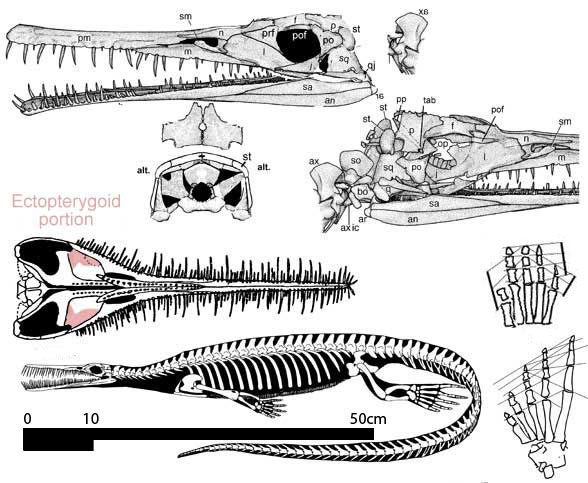
Mesosaurus tenuidens (Gervais 1864-66; MNHN 1865-77; Early Permian ~290 mya, up to 100 cm in length), was long considered a basal reptile related to those that never had temporal openings. Not so. Here the temporal opening are secondarily closed off. Derived from a sister to Stereosternum, Mesosaurus was not the last in this lineage (see below). Chronologically both were among the first reptiles to return to the water, but phylogenetically this was a derived taxon with no descendants.
Distinct from related taxa, the holotype of Mesosaurus (above, MNHN 1865-77) has five phalanges in manual digit 4. Distinct from the palatal view of an unknown specimen (above) the rostrum of the holotype is much wider than the mandible and the palatine + pterygoid has a different shape. Note the robust [pachyostosis] ribs.
The family tree of the Enaliosauria is here. The complete reptile family tree is here. A series on mesosaur and ichthyosaur palate evolution is here. |