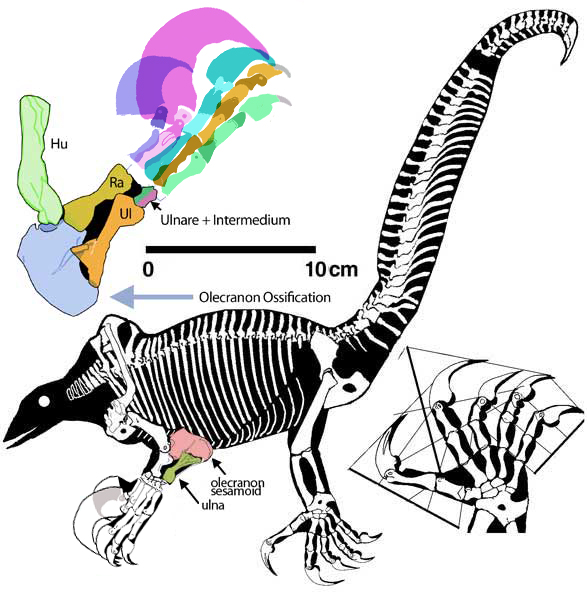
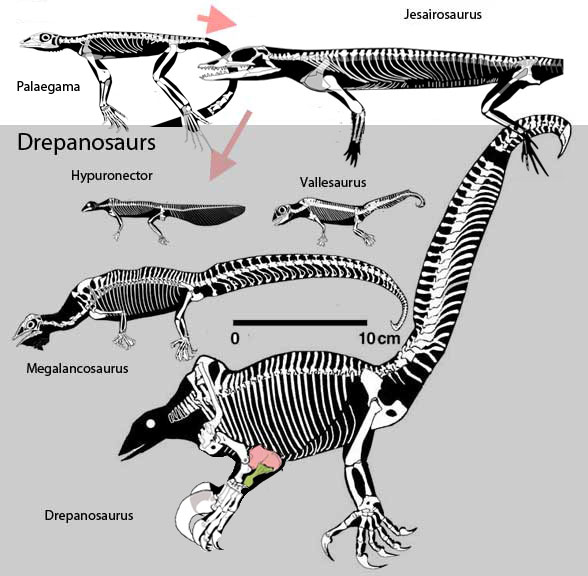
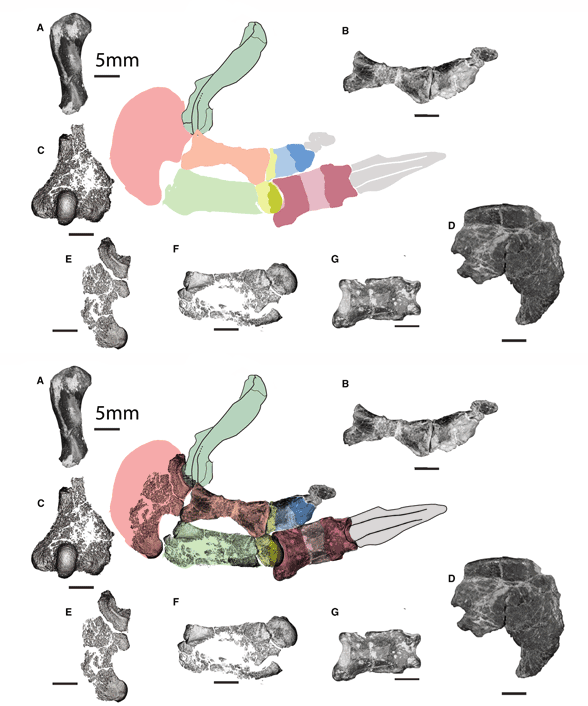
Drepanosaurus unguicaudatus (Pinna 1980) Norian, Late Triassic ~210 mya was originally considered an unusual lizard. Later studies (Renesto 1994) cast doubts. Here Drepanosaurus was derived from a sister to Vallesaurus and nested as a sister to Megalancosaurus, all within the Lepidosauria and the Squamata. Whereas Megalancosaurus developed a larger, longer body, Drepanosaurus developed a more compressed, deeper body twice the size of Vallesaurus. The skull is unknown. These taxa are all basal lepidosauriforms derived from a sister to Jesairosaurus.
Distinct from Vallesaurus, the cervical series of Drepanosaurus was strongly compressed. The dorsal neural spine hump was much taller along with all succeeding spines until the sacrum is reached. The sacral and anterior caudal neural spines are low to absent, but thereafter were elongated with expanded dorsal margins. The dorsal ribs were deeper. Several small vertebrae were sacralized. The fused chevrons were more robust and the terminal hook was as deep as the tail.
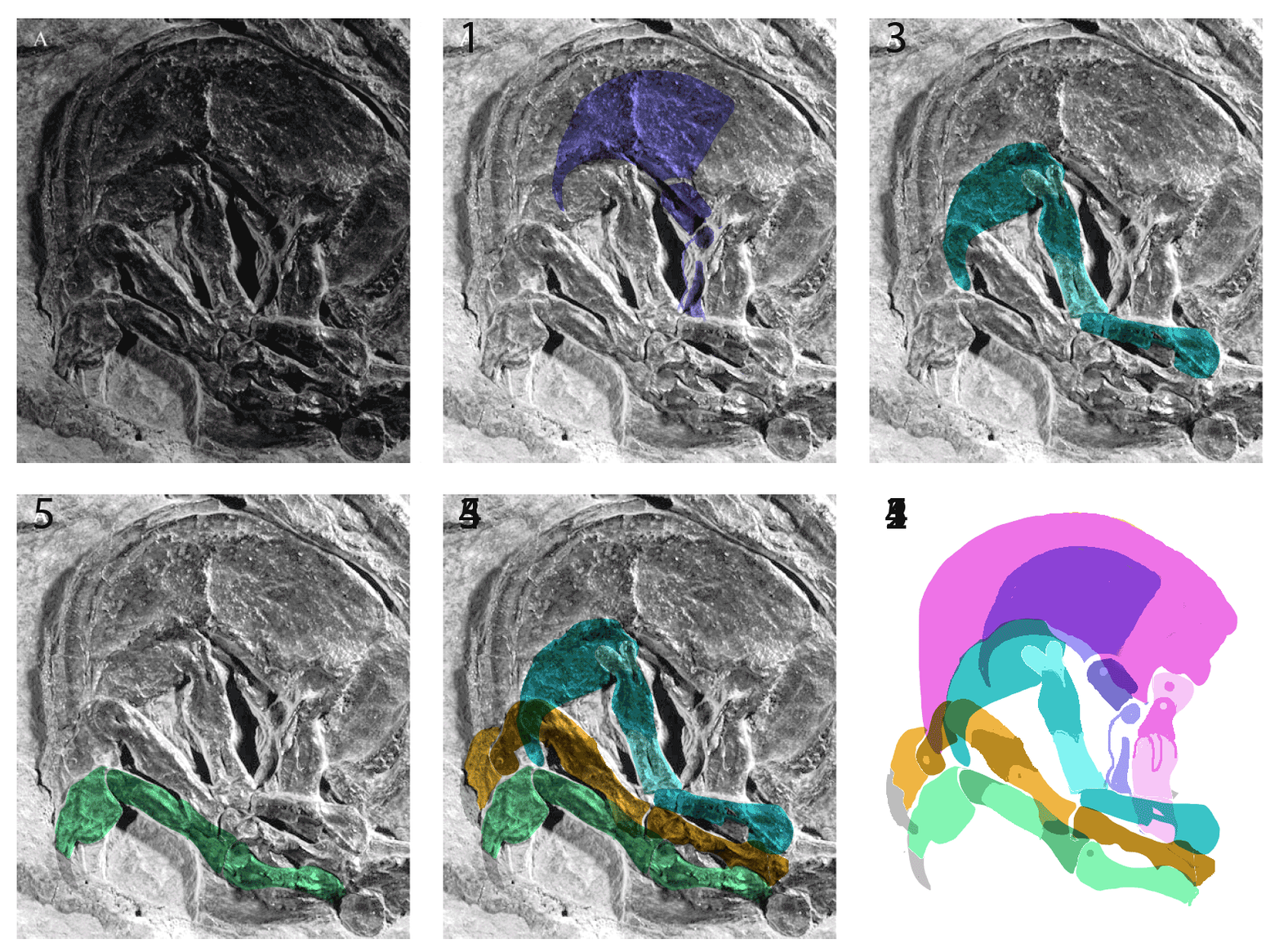
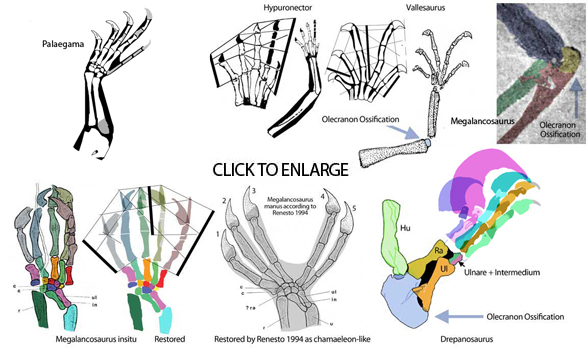
The scapula was relatively robust with a 70 degree bend at the bottom. The humerus and radius were short and robust. The ulna was not shifted to the elbow. That's the olecranon sesamoid, a bone found on other drepanosaurs, too. The manual claws were very large and capable of a large range of extension, like cat's claws. The finger phalanges were largely fused. Like the toes, the penultimate phalanges were extremely short.
The pelvis was relatively large and the pubis formed the majority of the ventral portion judging by the location of the thyroid fenestra. The hind limb was much larger than the forelimb. The tibia and fibula were broadly separated The astragalus and calcaneum were fused. The pedal unguals were the largest phalanges in each series. Digit I was divergent. |