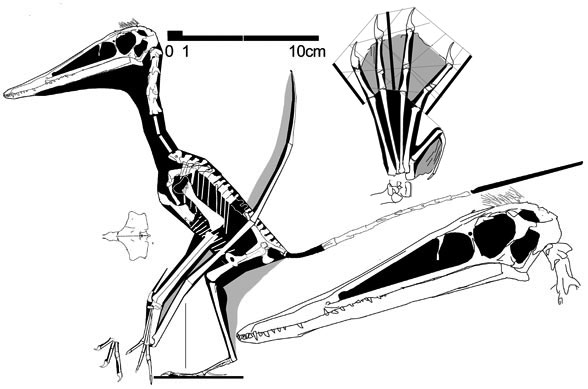
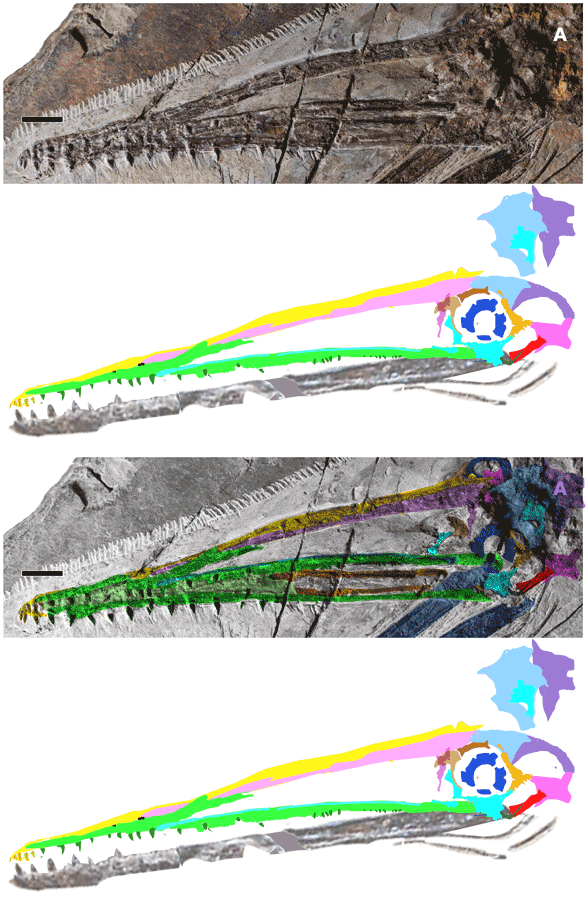
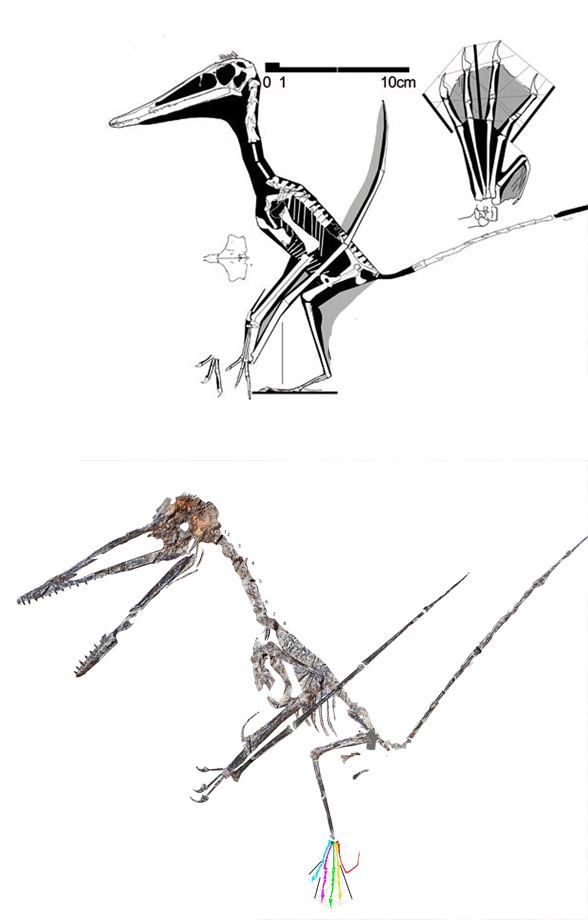
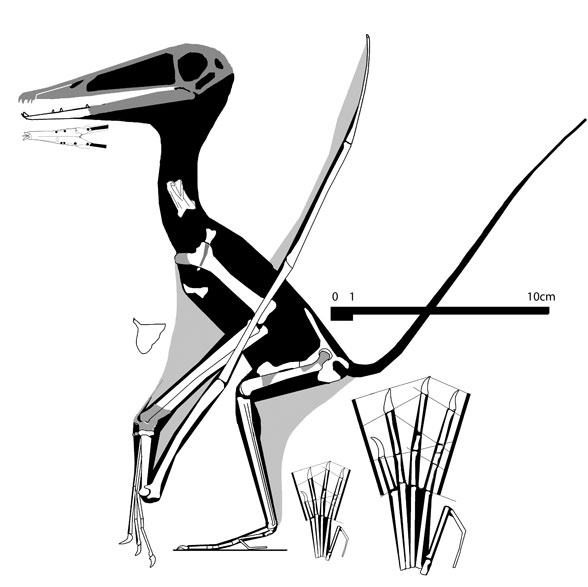
Kunpengopterus sinensisIVPP V16047 (Wang et al 2010) was derived from a sister to Pterorhynchus and phylogenetically preceded Darwinopterus and Wukongopterus.
Distinct from Pterorhynchus, the skull of Kunpengopterus was lower and had no distinct naris. The teeth were smaller.
The cervicals were longer. The dorsals were shorter.
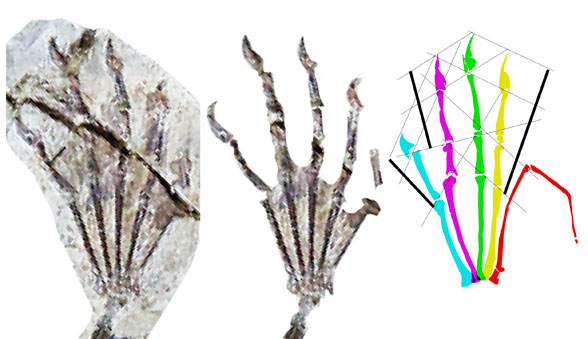
The sternal complex was pentagonal. The coracoid was more slender and curved. The radius and ulna were relatively shorter. The metacarpus was slightly longer. The wing finger was shorter, extending only to the base of the skull when folded.
The anterior process of the ilium was longer. The ischium was expanded posteriorly. The femur was longer and more robust. The metatarsals spread. Pedal digit 3 was longer. Unguals 2-4 weremore gracile and not aligned. Pedal digit 5 was shorter.
The disappearance of the naris used to be considered a trait restricted to "pterodactyloid"-grade pterosaurs. This led to some confusion in this clade because Kunpengopterus, Darwinopterus and Wukongopterus did not have the other traits considered common to "pterodactyloid"-grade pterosaurs: a long metacarpus, a short tail and an elongated pedal digit 5.
The Scaphognathia include Pterorhynchus, Scaphognathus, their most recent common ancestor and all of its descendants. One major clade includes the Cycnorhamphidae and Ornithocheiridae. The other major clade, originating with Ornithocephalus includes Pterodactylus, Germanodactylus and others.
Wang X, Kellner AWA, Jiang S-X, Cheng X, Meng Xi & Rodrigues T 2010. New long-tailed pterosaurs (Wukongopteridae) from western Liaoning, China. Anais da Academia Brasileira de Ciências 82 (4): 1045–1062.