Bennett SC 1996. Year-classes of pterosaurs from the Solnhofen Limestone of Germany: Taxonomic and Systematic Implications. Journal of Vertebrate Paleontology, 16(3):432-444.
Bennett SC 2007. A review of the pterosaur Ctenochasma: taxonomy and ontogeny. Neues Jahrbuch für Geologie und Paläontologie - Abhandlungen, 245(1): 23-31.
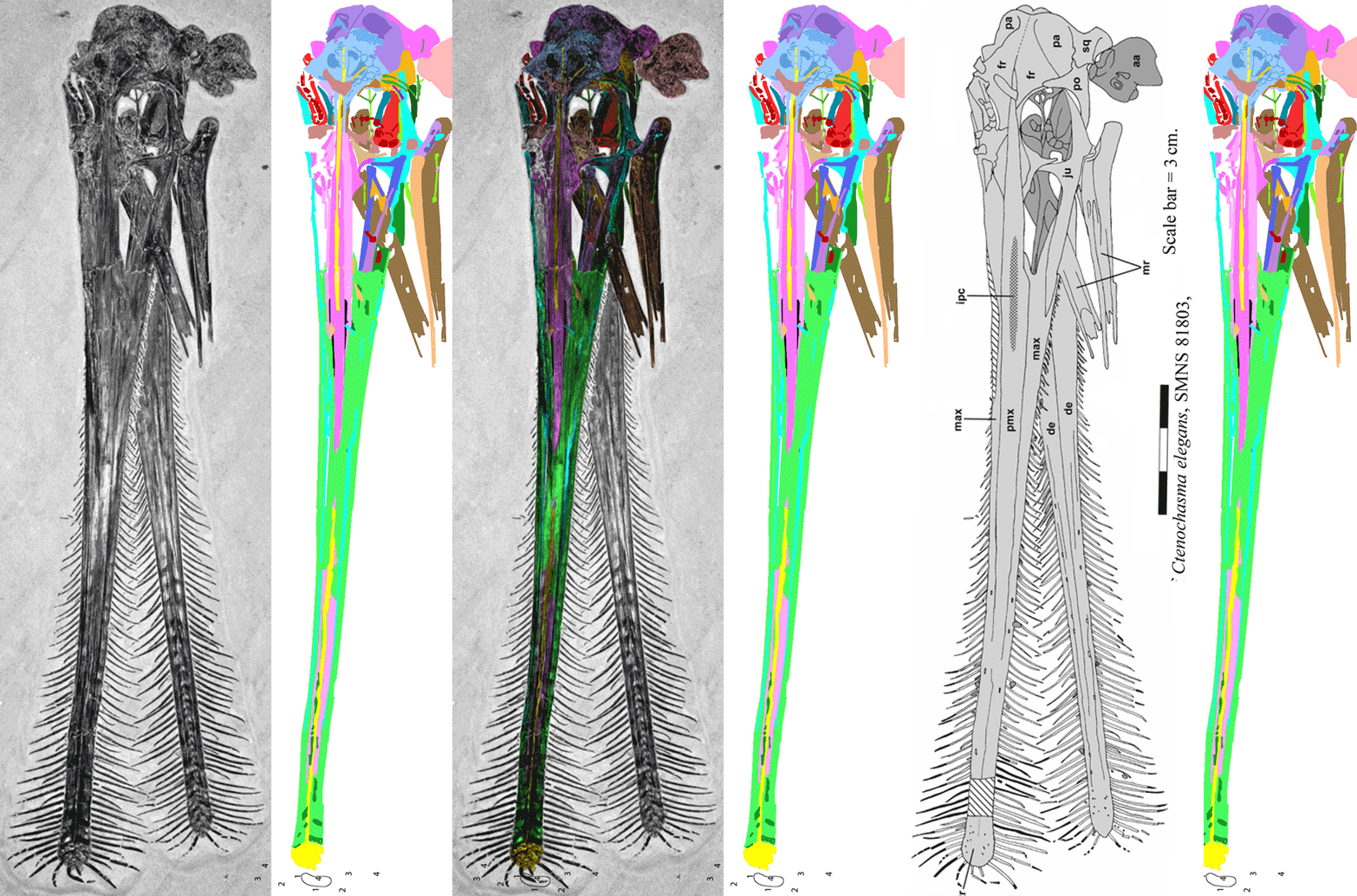
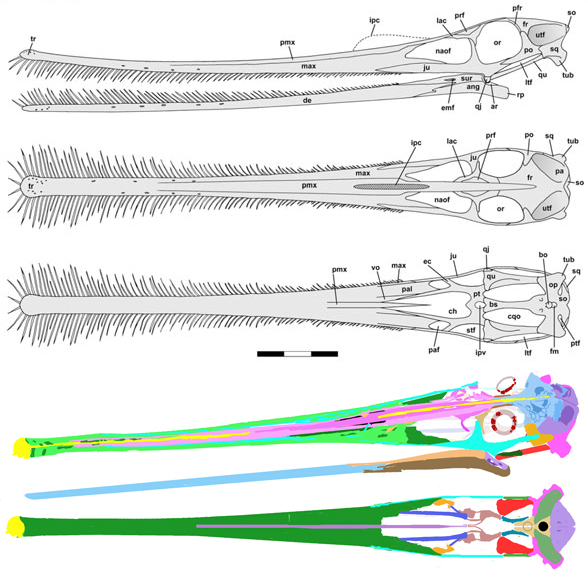
Bennett SC 2021. Complete large skull of the pterodactyloid pterosaur Ctenochasma
elegans from the Late Jurassic Solnhofen Lithographic Limestones. Neues Jahrbuch für Geologie und Paläontologie Abhandlungen . 301(3):283–294.
Buisonjé de PH 1981. Ctenochasma porocristata nov. sp. from the Solnhofen Limestone, with some remarks on other Ctenochasmatidae. Proceedings of the Koninklijke Nederlandse Akademie van Wetenchappen, B, 84 (4): 411-436. online
Jouve S 2004. Description of the skull of a Ctenochasma (Pterosauria) from the latest Jurassic of eastern France, with a taxonomic revision of European Tithonian Pterodactyloidea. Journal of Vertebrate Paleontology, 24(3):542-554.
Lü J, Kundrát M, Shen C 2016. New Material of the Pterosaur Gladocephaloideus Lü et al., 2012 from the Early Cretaceous of Liaoning Province, China, with Comments on Its Systematic Position. PLoS ONE 11(6): e0154888. doi:10.1371/ journal.pone.0154888
Martill DM, Frey E, Tischlinger H, Mäuser M, Riversa-Sylva HE and Vidovic SU 2023. A new pterodactyloid pterosaur with a unique filter-feeding apparatus from the Late Jurassic of Germany. PalZ https://doi.org/10.1007/s12542-022-00644-4
von Meyer CEH 1852. Ctenochasma Roemeri. Paläontographica, 2: 82–84 & pl. 13.
Oppel A 1862. Über Fährten im lithographischen Schiefer. Paläontologische Mitteilungen aus dem Museum des Koenigl." Bayrischen Staates, ed. A. Oppel, 1:121–125 & pl. 39. Stuttgart: Ebner & Sembek.
Taquet P 1972. Un crane de Ctenochasma (Pterodactyloidea) du Portlandien infe rieur de la Haute-Marne, dans les collections du Musee de St-Dizier. Comptes Rendus de l’Academie des Sciences, 174: 362–364.
Wagner JA 1861 Charakteristik einer neuen Flugeidechse, Pterodactylus elegans. Sber. k. bayer. Akad. Wiss. math.-phys. Kl. pp. 363–365.
Wellnhofer P 1970. Die Pterodactyloidea (Pterosauria) der Oberjura-Plattenkalke Süddeutschlands. Abhandlungen der Bayerischen Akademie der Wissenschaften, N.F., Munich 141: 1-133.
paleocritti/Ctenochasma
wiki/Ctenochasma
wiki/Balaenognathus |